
Why this is one of the best day trips from Zagreb
If you want a day trip that’s not just ‘pretty streets,’ Krapina is a standout: a world-famous paleoanthropology site paired with a modern, interactive museum.
Museums of Hrvatsko Zagorje notes the new museum opened in February 2010 and interprets the famous Krapina Neanderthal discovery with an experience-first, interactive exhibition.
What you’ll see (why it’s so memorable)
- An interactive permanent exhibition that takes you from deep time toward human evolution, with a special focus on Krapina and Hušnjakovo.
- A major diorama scene of Neanderthal life (one of the museum’s signature experiences).
- A clear connection between museum content and the nearby Hušnjakovo site (there’s a forest path connection).
How to get there from Zagreb
The museum’s official visitor info notes Krapina is about 50 km from Zagreb. The simplest option is driving; tours are also possible depending on season.
- By car: easiest and most time-efficient (especially for families).
- By organized tour: great if you want zero logistics.
- By public transport: possible, but plan carefully and leave buffer time.
How to plan the day (two good templates)
- Half-day: museum + Hušnjakovo path → lunch → back to Zagreb for an evening walk.
- Full-day: museum + Hušnjakovo → slow lunch → add another Zagorje stop (castle day or small town stroll).
Practical tips (so it doesn’t become stressful)
- Check working hours and ticket prices on the official MHZ pages before you go (hours change seasonally).
- If you’re visiting with kids, plan snacks and breaks — the museum experience is rich and sensory.
- If you want a guided tour or workshop, book in advance.
What a Krapina Neanderthal Museum day should add to the trip
Krapina is a focused prehistory and human-origins excursion whose museum gives the day a strong intellectual anchor. It suits families and adults who genuinely engage with archaeology and evolution.
A route and pace that make a Krapina Neanderthal Museum day work
Build transport around the museum’s current opening, allow time for interpretation and add the associated landscape or town only when it strengthens the theme and return remains comfortable.
The choices, trade-offs and common mistake
Choose Krapina for science, archaeology and a structured family learning day. Travellers seeking architecture or leisurely café streets may prefer Varaždin or Samobor.
Exhibition, language support, transport and site access need current verification. Parents should check content and duration against children’s ages rather than assuming every science museum is equally interactive.
Weather, current information and the fallback plan
If the journey fails, Zagreb’s Technical or Natural History museum can preserve the science theme. In Krapina, shorten secondary stops before compromising the return.
Who Krapina actually suits
Krapina is a depth-first day trip. Its central reason is one exceptional palaeoanthropological discovery and the museum built to interpret it, rather than a broad menu of scenery and attractions. Choose it for a real interest in human origins, geology, archaeology, museum interpretation or a family learning day. Visitors seeking a castle-and-lake landscape will find Trakošćan more direct; those seeking a town to wander should choose Varaždin or Samobor.
It also suits travellers willing to separate the museum from Hušnjakovo access. Official pages do not all describe the outdoor site with the same freshness, and an expansion project continues through 2027. The museum must justify the journey by itself; the archaeological landscape should be a separately confirmed second chapter. If the day only feels worthwhile when the site path is open, contact the institution before committing to transport.
Museum first is an interpretive choice
Hušnjakovo is not visually self-explanatory. The protected site matters because of the evidence recovered and the scientific work that made it meaningful, not because a visitor can simply look at rock and reconstruct the story. Begin inside, where deep time, evolution, excavation and the Krapina material are placed in sequence. Only then can the terrain function as more than an outdoor photo stop. This order also ensures that an unexpected site closure does not erase the substantial part of the visit.
Give the museum one uninterrupted block before lunch or town time. Moving in and out breaks a narrative designed to build from general context to local evidence. If a combined expert tour is the priority, reserve it in advance and confirm that the site portion is actually available. Do not assume a combined-tour description guarantees every route on every date; reservations and live access remain separate questions.
How the eighteen thematic units carry the story
The official museum profile says the permanent exhibition is organised into eighteen thematic units, travelling from the oldest history of Earth towards civilisation and the modern age, with special emphasis on Krapina’s discovery and collection. That broad opening prevents the local fossils from appearing without evolutionary or geological context. It also means the first rooms are not a preface to skip. They establish the timescale and scientific questions needed later.
Pace will naturally change when the story becomes local. Move steadily through general concepts that are already familiar, then slow for the excavation, evidence and interpretation that make Krapina distinctive. Around nine hundred human fossil bones and fragments, numerous Pleistocene animal remains and more than a thousand stone tools were recovered according to the official profile. Those numbers indicate the scale of the research resource; they should not be turned into a promise that every item is displayed.
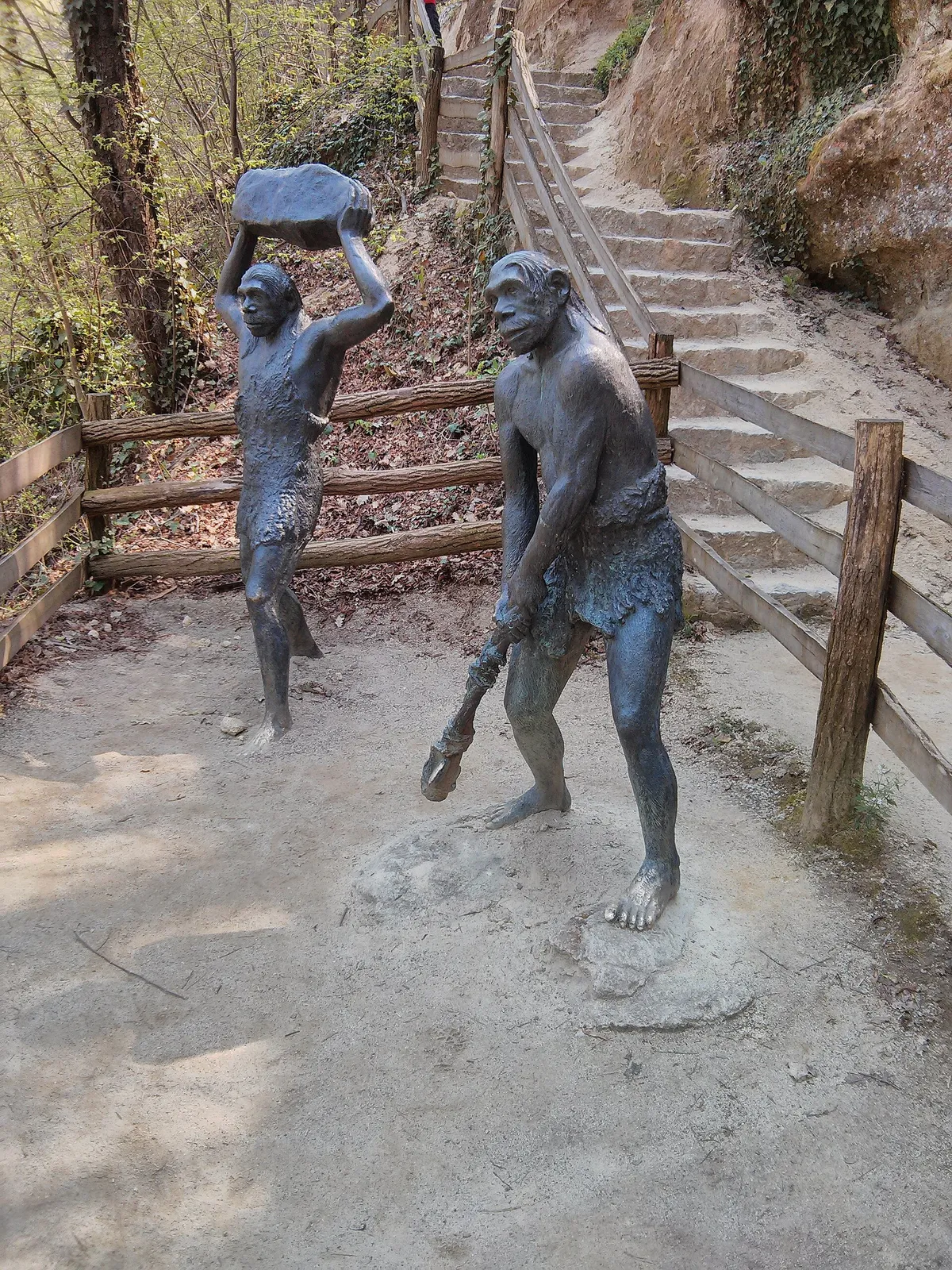
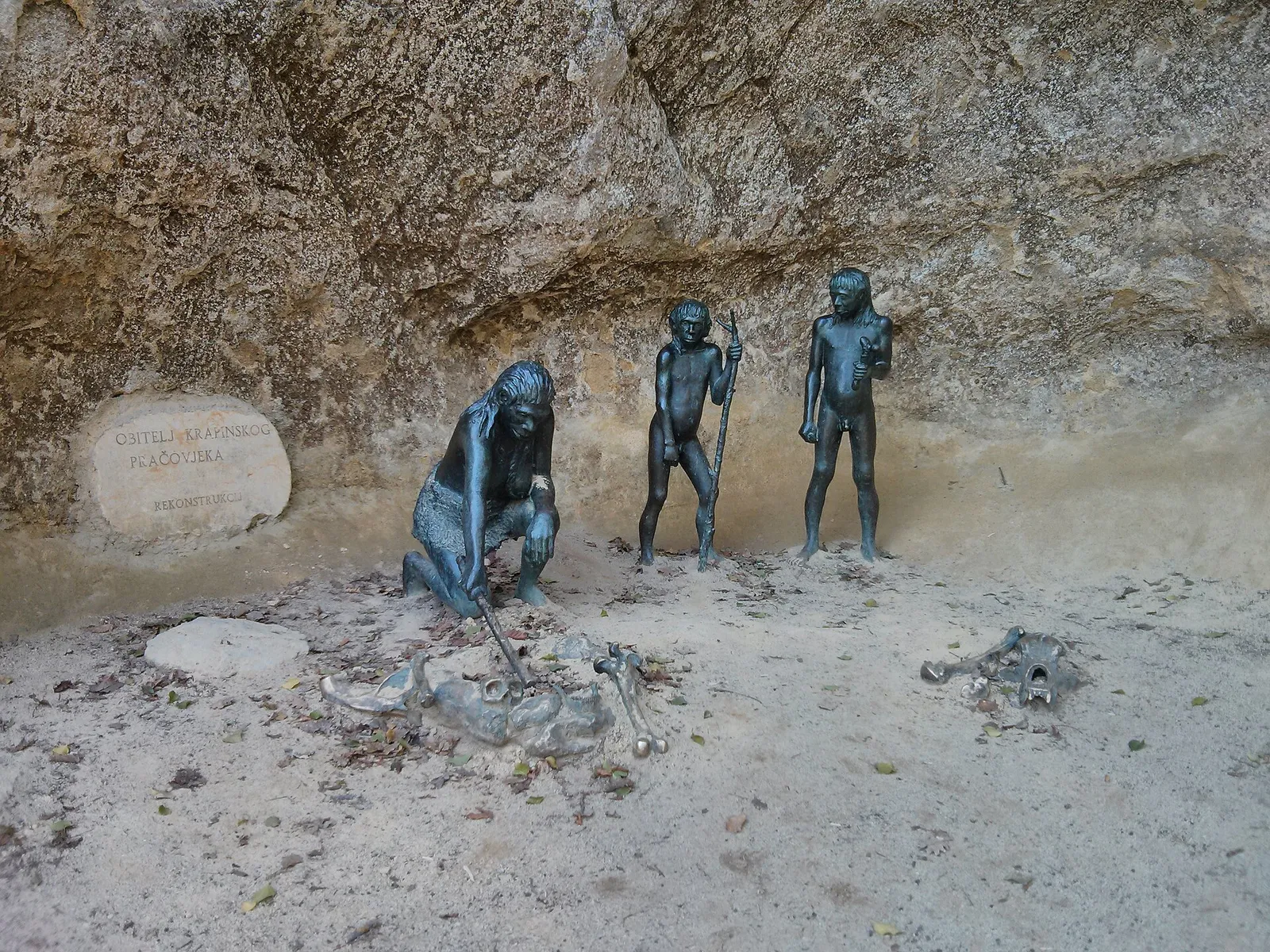
Read each object label to distinguish original material, casts, models, reconstructions and multimedia. A reconstruction visualises a scientific interpretation; it is not a direct photograph of Neanderthal life. A cast can communicate form while protecting another object. The museum’s quality lies partly in making those different kinds of evidence work together, and visitors get more from the display when they notice the boundary instead of calling everything a fossil.
The building and Hušnjakovo were designed as one visit
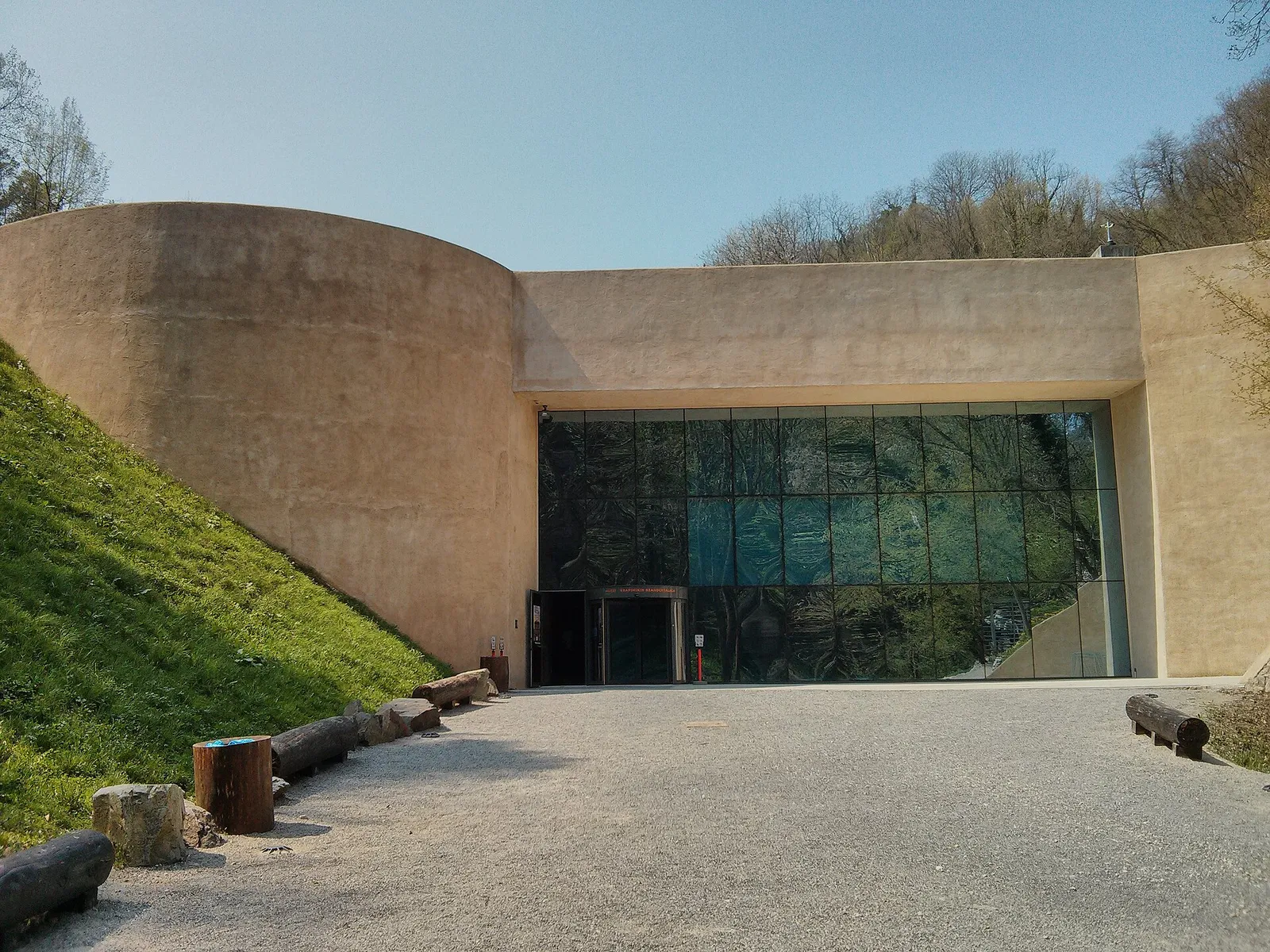
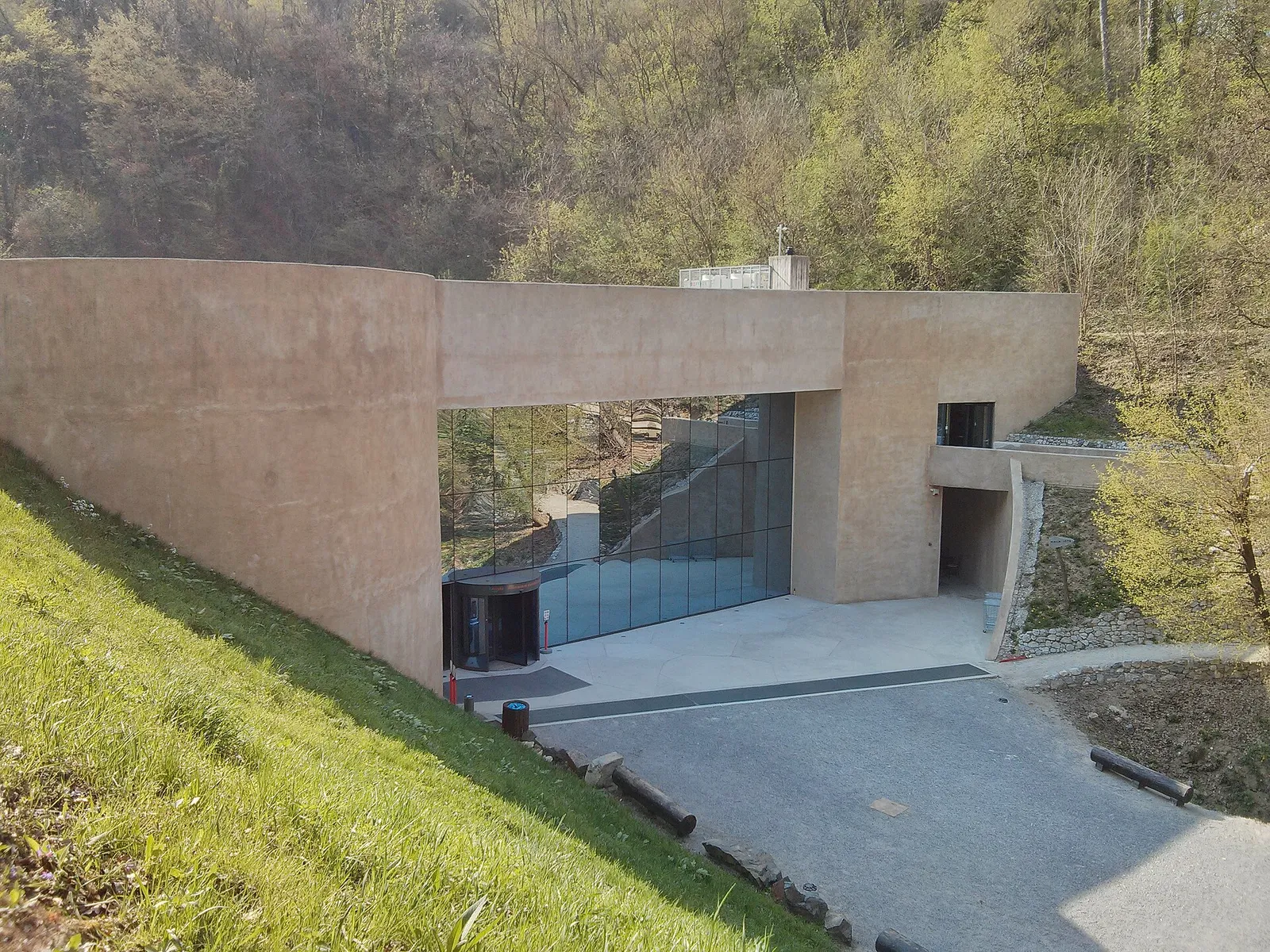
The museum architecture is embedded between hills near Hušnjakovo and intentionally evokes the former semi-cave associated with the site. Its visible facade, earth-toned surface, concrete interior and relationship with water and wooded slopes make the building an interpretive instrument, not neutral packaging. Notice how the approach moves into a structure that partly reads as landform; that choice connects modern exhibition space to the landscape whose evidence it explains.
This architectural relationship still matters when the outdoor path is unavailable. Look back from the approach, see how the glazed entrance reflects the setting and notice how much of the volume is held within the slopes. The site and building were intended as a whole, but one can continue to explain the other when access creates a temporary boundary. Do not cross works, closed gates or terrain limits to force the ideal combined experience.
Confirm Hušnjakovo and construction conditions directly
Use the current Museums of Hrvatsko Zagorje visitor page for live museum hours and tickets, but resolve outdoor-site access separately. An older official museum page still carries outdated kuna prices alongside a notice that the site is temporarily closed. That mixture proves why no single archived visitor page should settle the plan. Ask the museum whether Hušnjakovo is open, which approach is in use and whether a combined tour is operating on the exact date.
A visitor-centre expansion project is scheduled through 2027 and may affect the approach or facilities at different stages. Do not speculate about noise, barriers or completion from the project dates alone. Check the museum’s current notice and follow the route provided on arrival. When works remove the site path, keep the museum and a short legal exterior architecture study; when they affect the museum itself, postpone unless the institution confirms a viable alternative.
The accessibility boundary is museum versus site
Older official access information describes the exhibition as accessible to accompanied visitors with disabilities while stating that the Hušnjakovo path is not wheelchair-accessible because of the terrain. Treat that as a warning about the boundary, then request current detail—especially while new accessibility work is part of the expansion project. Ask about the approach from parking or transport, entrance, lifts or ramps, toilets, seating and the exact outdoor surface rather than accepting one broad accessibility label.
Plan the museum as the more controlled part and the site as conditional. A mixed-mobility group can still share the indoor interpretation, then divide only if the outdoor route is confirmed and everyone has a clear meeting point. Do not frame the non-wheelchair-accessible site path as a challenge to overcome. The protected terrain and a visitor’s comfort establish a real boundary, not a lack of determination.
Families, sensory pacing and current photography rules
The exhibition uses interactive and multimedia interpretation, shifting atmosphere and a large Neanderthal diorama. Older children interested in science can follow the full arc; younger visitors may respond more to particular images, models and tactile or digital moments than to every unit. Do not insist on equal time in all eighteen sections. Choose a few questions—how the site was found, what evidence survives, how interpretation is built—and let those organise the family visit.
Lighting, sound, dense information and an enclosed cave-like concept can tire visitors differently. Build a pause before the local-evidence chapters rather than racing the second half. Solo visitors can read more deeply; couples can divide attention between science and architecture. Any group should follow current staff guidance for backpacks, food, touchable elements and photography. An older official page prohibits interior photographs, so never assume normal phone photography is allowed just because a display looks robust.
Transport, town time and the Trakošćan trade-off
Krapina is about fifty kilometres from Zagreb according to the official museum site. Driving gives the simplest control over museum entry, site confirmation and a possible second stop. Public transport can work only after checking the exact date, station-to-museum approach and return; do not preserve a timetable in evergreen prose. Save a later fallback connection and enough walking margin. A museum that closes before a delayed arrival offers no flexible outdoor substitute when Hušnjakovo is also unavailable.
Use Krapina town for a practical meal or short walk, verifying a chosen venue directly instead of inventing a mandatory local address. Pair Trakošćan only by car, with both museums confirmed and an early start. The pairing creates two dense historical-scientific interiors plus outdoor terrain; it is not automatically better value than giving Krapina’s narrative time to settle. Families and slow museum readers should usually choose one major site and a relaxed meal.
Weather, return timing and the final checks
Krapina holds up better in rain than landscape-led day trips because the museum carries the main argument indoors. Bad weather still affects the approach and removes value from an open Hušnjakovo path, so choose the museum-first version and keep the town pause short. In heat, confirm whether any outdoor section has shade and water before adding it. Do not let a museum ticket create pressure to use terrain that current conditions make uncomfortable.
Fix the return before entering the exhibition, especially by public transport. The later thematic units are the reason to visit and should not be rushed because the group never checked the journey home. Leave a buffer for shop, toilets, the walk from the museum and any temporary construction route. If the time available cannot hold the full permanent display, choose another day rather than skipping the Krapina evidence that gives the museum its point.
- Use the current MHZ page for museum information and contact staff about Hušnjakovo.
- Reserve and reconfirm any combined museum-and-site guided tour.
- Ask where today’s accessible route ends; do not assume it includes the site path.
- Follow current photography and interactive-display rules.
- Confirm transport home before beginning the eighteen-unit exhibition.
Questions people actually ask
Is the Krapina Neanderthal Museum good for kids?
Yes — it’s designed as an interactive, experience-driven museum. Families generally find it engaging, especially when paired with the outdoor path to Hušnjakovo.
How much time should I plan?
Plan 2–3 hours for the museum itself, plus travel time. If you add the Hušnjakovo path and a slow lunch, it becomes a full, satisfying day trip.